Every Event Organizer Is a Local Media Publisher
- Tunji Williams

- Aug 10
- 4 min read
Updated: Aug 11
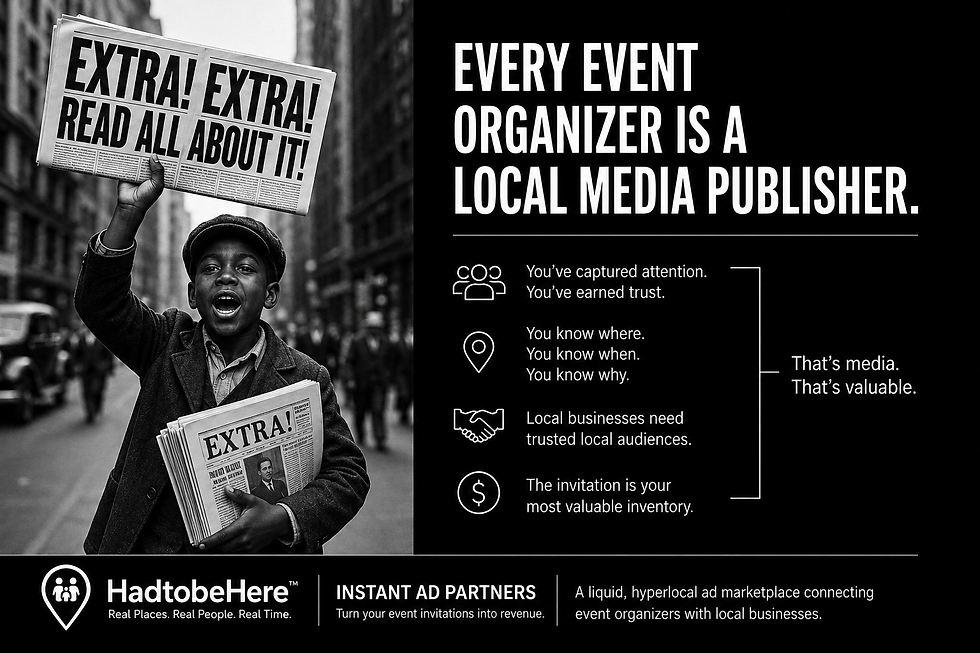
I’ve been thinking a lot lately about what exactly an event organizer creates when they organize an event. The obvious answer is the event. But, I think there’s another answer hiding in plain sight. They create media.
Think about it with me for a moment. If I organize a birthday party and convince 75 people to spend their Saturday night with me, I’ve done something increasingly difficult in today's fragmented social world: I’ve captured the attention of 75 people and convinced them to physically go somewhere.
A student organization that gets 300 students to a campus mixer has done the same thing. So has the promoter bringing 500 people to a venue, and the team organizing a festival for 50,000 people. The scale is different, but the underlying behavior isn’t.
In each case, someone has aggregated a discrete audience around a specific person, place, time and experience.
The Trust Factor.
There’s something else that makes this audience particularly interesting.
The Trust factor. And that's key if we think of the event invitation as the publication.
For most of my life, I’ve thought about local media in pretty conventional terms: newspapers, radio, television, magazines, blogs. Later in the evolution came social media and influencers. But what is an event invitation? An organizer chooses an experience, describes it, curates the audience, recommends a place and effectively says:
You should be here. And people listen.
That simple, but powerful dynamic makes the invitation itself an interesting little piece of media inventory. Nielsen's research on trust in advertising found that 88% of respondents most trust recommendations from people they know. Meanwhile, BIA projects that American businesses will spend about $184.5 billion on local advertising in 2026. Those two facts have been bouncing around my head together.
Local businesses spend enormous amounts of money trying to reach local people.
Event organizers are constantly assembling highly specific groups of local people who trust them. Why isn't there a simple marketplace connecting the two?
You're organizing a birthday party for 100 people in Baltimore. A restaurant two blocks from the party would probably love to know that 100 people—many of whom presumably know one another—are going to be in that exact neighborhood at 8 p.m. Saturday. That's not 100 impressions. It's not 100 people whose cookies suggest they might be interested in Baltimore nightlife. It's 100 actual human beings who have said: I'm going to be there.
That's an unusually valuable audience. Maybe the restaurant offers everyone at the party 15% off dinner beforehand, or a free appetizer afterward. The restaurant gets access to a hyperlocal, high-intent audience. Guests get something genuinely useful.
And why shouldn't the person who assembled the audience get paid?
Now, scale that idea up.
This gets more interesting the longer I sit with it. Tripleseat reported that its hospitality customers booked 4 million events and catering occasions in 2024 alone, representing $8.4 billion in event revenue. Not all of those are large events, obviously. But using that activity and other industry data as anchors, somewhere around 2 to 4 million hospitality-based social events with 50+ attendees happen annually in the United States.
Call the midpoint roughly 3 million. And that's before you start thinking about all the smaller gatherings: birthday parties, alumni mixers, fraternity and sorority events, running clubs, weddings, professional happy hours, community gatherings, conferences, festivals, Pride, Tech Week. The list gets very long, very quickly. Each is its own temporary micro-community. And I think each organizer is, in a small but meaningful way, a micro-media publisher.
So we're building the marketplace.
This is the idea behind Instant Ad Partners, a feature we're building into HadtobeHere.
When you create an event, we want finding a relevant local advertising partner to be almost as easy as adding another guest. Search nearby businesses. Find one that makes sense for your audience. Set a price for placement on your invitation.
Send the business an offer. The business sees the event, audience size and context and can submit an in-person offer for your guests. You approve it. They get distribution.
Your guests get something useful. You get paid.
No sponsorship deck. No advertising sales team. No 45-email negotiation with the marketing manager. The invitation becomes monetizable right away.
And the really interesting part to me, is that the organizer doesn't have to be a professional organizer.
Attention belongs to the people who earn it.
This is the piece I keep coming back to. The internet created an enormous economy around monetizing our attention. But most of the value accrues to the platforms sitting between the person who creates the audience and the people inside it. Events offer an interesting opportunity to rearrange that equation. If you can consistently get people to show up, you've built distribution. If those people trust you enough to act on your recommendations, you've built something even more valuable. You've built a high-trust distribution engine. I think local businesses will pay for access to that. And I think organizers should participate in the economics.
The person organizing a 75-person pool party and the organization producing a 75,000-person festival obviously aren't the same kind of publisher. But they're doing something remarkably similar: turning trust into attention, and attention into physical presence.
That's the marketplace we're trying to build with HadtobeHere.
Millions of little media properties, appearing and disappearing across the physical world every day. Maybe the future of local media isn't another website or social feed.
Maybe it's the invitation.


Comments